Frequent travelers tend to share one habit: they recognize flags. You see them on aircraft tails, at border crossings, on departure boards, and on hotel reception desks. If you want to turn that casual recognition into real knowledge, a guess the country game is one of the most efficient ways to do it — and CountryClue is a strong example of the format done right.
In this review, we break down how the game works, what each difficulty mode offers, and why it fits naturally into a traveler’s daily routine.
What Is CountryClue?
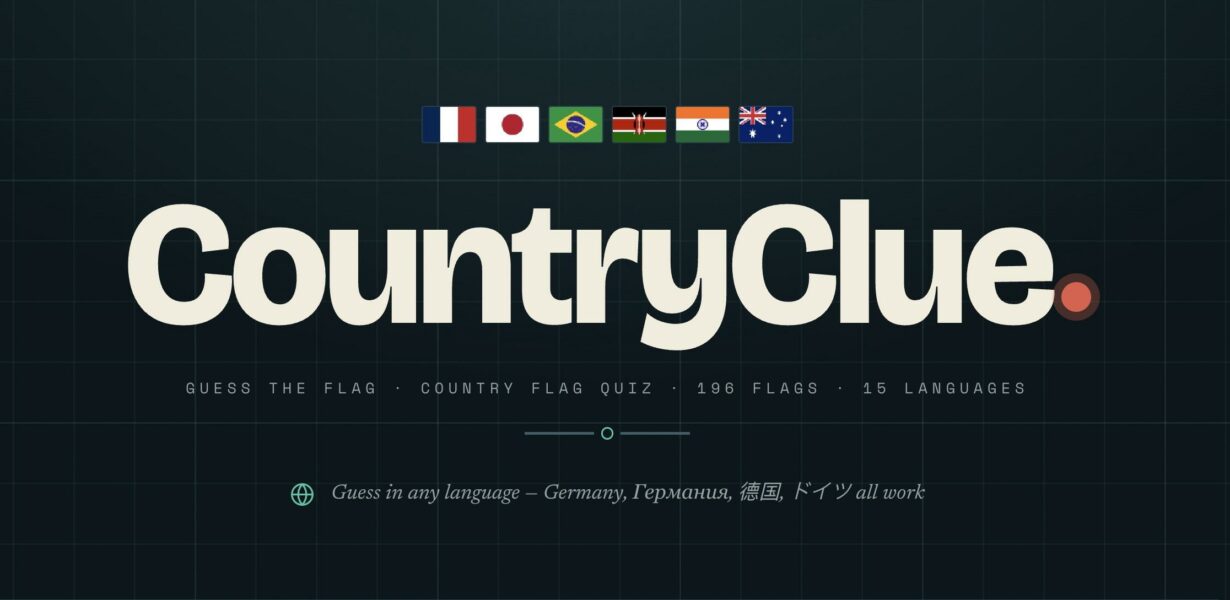
CountryClue is a free browser game built around a simple task: identify a country from its pixelated flag. You get 6 attempts per round. Each wrong guess sharpens the image and reveals a new clue — continent, capital city, population, neighboring countries, and land area — until you either name the country or run out of tries.
If you have played Wordle, Worldle, or Flagle, the loop will feel familiar. The difference is in the details:
- 196 country flags — the full world map, not a shortened list of “popular” states.
- Multilingual input in 15 languages — type “Germany”, “Германия”, “Deutschland”, “德国” or “ドイツ”, and the game accepts all of them.
- Four game modes — from a shared daily challenge to an expert mode with no hints.
- No ads, no sign-up — the game opens instantly in any browser, on desktop or mobile.
- Built-in statistics — games played, win percentage, current streak, and guess distribution.
How to Play: The Core Loop
A round takes one to three minutes. Here is the full sequence:
- The game shows a heavily pixelated flag of a mystery country.
- You type a country name in any of the 15 supported languages and submit your guess.
- If the guess is wrong, the flag becomes slightly clearer and a new clue appears — first the continent, then the capital, population, neighbors, and land area.
- You repeat until you name the country or use all 6 attempts.
- The game records the result in your statistics and, in Daily mode, lets you compare the score with friends.
The clue order is the clever part. Continent narrows the search to a region. Capital and population usually settle it for well-known countries. Neighbors and land area are what separate players who can tell Zambia from Zimbabwe on a map from those who cannot — yet.
Game Modes Compared
CountryClue ships with four modes, and the difference between them is meaningful, not cosmetic. This table sums up who each mode is for:
| Mode | Country Pool | Blur Level | Continent Hints | Best For |
|---|---|---|---|---|
| Daily Flag | 1 country per day, same for everyone | Standard | Yes | Playing against friends; a new flag drops at midnight |
| Easy | ~60 famous countries | Gentle | Yes | Beginners, kids, a relaxed warm-up |
| Medium | All 196 countries | Standard | Yes | Regular practice across the full world map |
| Hard | All 196 countries | Heavy pixelation | No | Experts who want zero assistance |
The Daily Flag mode is the social anchor: one country a day, identical for every player worldwide, which makes score comparison fair. The unlimited modes are where the actual learning happens, because you can play as many rounds as you want.
Why Travelers Should Care About a Guess the Country Game
A flag quiz sounds like entertainment, and it is — but for people who fly regularly, it doubles as practical training.
Flags Are Everywhere in Air Travel
Airline liveries, airport signage, visa stamps, currency exchange boards — flags are the visual shorthand of international travel. Recognizing them instantly saves small amounts of time and confusion at every step of a trip.
The Clues Teach Real Geography
Because wrong guesses reveal the capital, population, neighbors, and land area, every failed round still deposits facts you will actually use: which countries border which, roughly how big they are, and what their capitals are — the same kind of data you would otherwise look up in the CIA World Factbook. After a few weeks of daily play, you stop confusing Slovenia with Slovakia — a mix-up that has sent more than one parcel, and occasionally a traveler, to the wrong country.
Multilingual Input Doubles as Language Practice
The 15-language input is unusual for the genre. If you are learning Spanish, French, German, Japanese, or Arabic, you can answer in that language and quietly drill country names as vocabulary. For multilingual families, everyone can play the same round in their own language.
What Stands Out — and What to Know Before You Play
Strengths
- Zero friction. No account, no ads, no install. The round starts the moment the page loads.
- Full 196-country coverage. Many flag quizzes stop at the famous 50; here the long tail of Pacific and African states is in play.
- Honest difficulty curve. Easy mode is genuinely easy; Hard mode, with heavy pixelation and no continent hints, is genuinely hard.
- Progress tracking. Win percentage, streaks, and guess distribution give you a measurable sense of improvement.
- Cross-device play. The interface works equally well on a phone in an airport lounge and on a desktop at home.
Things to Keep in Mind
- The Daily mode offers one flag per day — if you want more, switch to Easy, Medium, or Hard for unlimited rounds.
- Statistics are stored in your browser, so switching devices means starting a fresh streak.
- Hard mode assumes you already know your flags; new players should not start there.
A Simple Way to Build the Habit
If you want the game to actually improve your geography rather than just fill two minutes, a light structure helps:
- Week 1–2: play the Daily Flag plus a few Easy rounds to learn the mechanics.
- Week 3–4: move to Medium and pay attention to the neighbor and area clues — that is where the learning is.
- Month 2: test yourself in Hard mode and watch your win percentage in the statistics panel.
Pair it with your travel planning: before a trip, play a few rounds and see whether you can identify your destination’s neighbors. It is a low-effort way to arrive slightly better informed than you left.
FAQ
What is CountryClue?
CountryClue is a free online guess the country game. It shows a pixelated national flag, and you have 6 attempts to name the country, with clues (continent, capital, population, neighbors, land area) revealed after each wrong guess.
Is it similar to Flagle or Worldle?
Yes. It follows the same Wordle-style daily format, but adds multilingual input in 15 languages, four difficulty modes, and unlimited practice rounds alongside the daily challenge.
How many flags are in the game?
All 196 country flags. Easy mode uses a pool of about 60 well-known countries; Medium and Hard cover the full set.
Do I need to create an account?
No. The game runs in the browser with no sign-up, no install, and no ads. Statistics are tracked locally on your device.
Can I answer in a language other than English?
Yes. The game accepts country names in 15 languages, including English, Spanish, French, German, Russian, Ukrainian, Italian, Portuguese, Chinese, Japanese, Korean, and Arabic.
Is CountryClue suitable for kids?
Yes. Easy mode with famous countries and gentle blur works well for children and classroom use, and the absence of ads makes it safe to hand over on a family device.
Where can I play?
The game is available at countryclue.online — it works in any modern browser on desktop and mobile.
The Bottom Line
CountryClue takes a proven format — the daily guessing game — and executes it with more depth than most competitors: full 196-country coverage, four calibrated difficulty modes, multilingual input, and no monetization friction. For travelers, it is a two-minute daily ritual that steadily converts flags from decorative background into useful knowledge. Open it once with your morning coffee, and the streak counter will do the rest.