
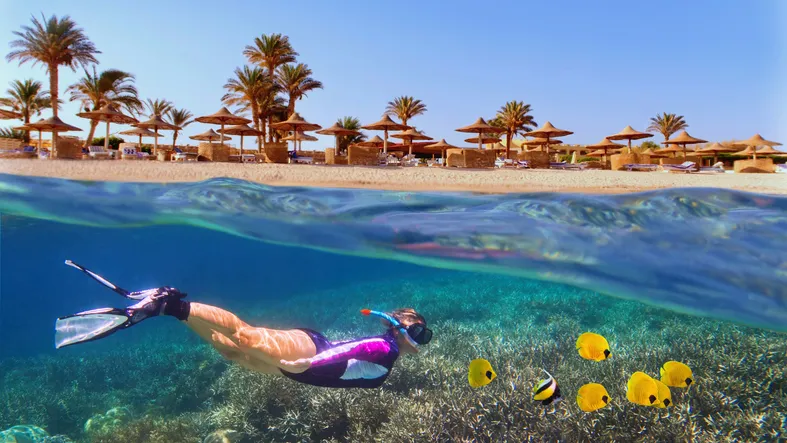
Egypt is one of those countries where the name alone is enough to excite a diver. The Red Sea has a reputation that goes back decades, built on extraordinary visibility, warm water, and reef systems that pack more life into a single dive than most oceans manage in a week. But Egypt is not one diving destination. It is several, and they are not equal. If you are planning a dive trip and you are serious about what you want to see underwater, the choice of where in Egypt to go matters enormously. This article makes the case for Marsa Alam, and by the end of it, the case should be clear.
The Problem With Playing It Safe
Most first-time visitors to Egypt end up in Hurghada or Sharm el-Sheikh. Both are easy to reach, well-served by budget airlines, and surrounded by hotels at every price point. The diving in both places is not bad. It is fine. But fine is a word that should make any diver nervous, because fine means you are leaving an enormous amount on the table.
The reefs around the popular northern resorts have been under sustained pressure for thirty years. The marine life is thinner than it used to be, the coral cover in many areas has been reduced by a combination of anchor damage, runoff, and careless diving, and the sites are often shared with large groups of beginners and snorkellers. You can still have a good dive. You are unlikely to have a great one.
Marsa Alam sits roughly 200 kilometres further south, and those kilometres represent a completely different relationship between tourism and the sea. Development here came later, the protected areas were established earlier relative to the level of visitor traffic, and the result is a marine environment that still has the density and diversity that Egypt was once famous for across its entire coastline.
What the Water Actually Looks Like
Visibility in Marsa Alam is one of the first things divers talk about when they come back. On a typical day at most sites you are looking at 25 to 40 metres of clear blue water. On calm days at offshore reefs that number can stretch further. The clarity comes partly from the low nutrient levels in the southern Red Sea and partly from the absence of the heavy boat traffic and coastal disturbance that clouds the water further north. Descending at a site like Elphinstone on a good day and looking out into that deep blue while the wall drops away beneath you is an experience that photographs cannot really capture.
The coral is the other thing that surprises people. Hard coral formations that would be a highlight in most of the world are commonplace here. Soft corals in purples, oranges, and reds drape the walls of the offshore reefs in layers. Sea fans grow to dimensions that make you realise how slowly they are growing and how long it takes to produce a reef system like this. It feels less like diving and more like visiting something ancient and still intact.
The Dive Sites You Cannot Miss
Elphinstone Reef
Elphinstone Reef is the site that puts Marsa Alam on the global diving map, and it earns that status on every dive. The reef is an offshore plateau in open water, elongated north to south, with walls that drop vertically into water so deep it turns from blue to black before you can see the bottom. The soft coral growth on those walls is among the most spectacular in the Red Sea. At the northern and southern tips, where the currents concentrate the plankton and the food chain builds upward from there, oceanic whitetip sharks are a genuine and relatively reliable presence. This is one of the few places in the world where you can plan a dive around seeing a pelagic shark in open water and have a reasonable chance of the plan working out. Grey reef sharks, silvertips, and hammerheads add to the possibility list depending on the season.
Dolphin House — Shaab Samadai
Dolphin House Marsa Alam occupies a category of dive site that very few places in the world can offer: a location where a wild animal population has chosen to be, returns to voluntarily every day, and can be encountered in the water with minimal disturbance to their natural behaviour. The spinner dolphins that use the horseshoe-shaped lagoon at Shaab Samadai are not performing. They are resting, playing, and raising their young in a place they have decided is safe. Egyptian authorities regulate access carefully, dividing the lagoon into zones and limiting the number of people in the water at any one time. The reef itself is healthy and full of life, but the dolphins are the memory you take home.
Abu Dabbab
If you have never seen a dugong in the wild, Abu Dabbab is where to start looking. The sheltered bay with its seagrass meadows is one of the most reliable places in the world to find these animals, and the turtles here are equally impressive in their density and their complete calm around divers. The site is accessible to all levels and the shallow, clear conditions make it ideal for underwater photography. A morning at Abu Dabbab followed by an afternoon at a deeper reef site gives you the full spectrum of what Marsa Alam offers in a single day.
Rocky Island and Zabargad
Further south, accessible by live-aboard, Rocky Island and Zabargad are among the most remote and rewarding sites in the entire Red Sea. Rocky Island in particular has a reputation for hammerhead sharks and the kind of pelagic diversity that only truly isolated reefs produce. These are sites where the absence of day-trip boat traffic is itself part of the experience, and descending into that isolation with no one else around is something that stays with you long after the dive is over.
The Dugong Question
Dugongs deserve a paragraph of their own because they are so rarely seen elsewhere and so comparatively accessible in Marsa Alam. These animals are listed as vulnerable to extinction globally and have disappeared entirely from much of their former range. The seagrass beds along the southern Egyptian coast are one of their strongholds, and several sites in the Marsa Alam area offer genuine, consistent opportunities for encounters. Seeing a dugong in the wild — a large, slow, ancient-looking mammal grazing on the seafloor in complete indifference to your presence — is the kind of encounter that resets your sense of what diving can be.
Live-Aboard Versus Land-Based: Which Makes More Sense Here?
Both options work well in Marsa Alam and the right choice depends on what you are looking for. A land-based trip gives you comfort, flexibility, and access to the excellent house reefs and nearby day-trip sites. It suits divers doing courses, those travelling with non-divers, or anyone who wants the option of a day away from the water without feeling like they are wasting a boat berth.
A live-aboard based out of Marsa Alam opens up a different scale of trip entirely. The southern Red Sea route typically takes in Elphinstone, the St Johns reef system, Rocky Island, and Zabargad over the course of a week, covering sites that are completely inaccessible to day boats and diving with four or five dives per day at reefs that see very little traffic. For a diver who wants to maximise time underwater and push into genuinely remote territory, a southern Red Sea live-aboard is one of the best dive trips available anywhere in the world.
Courses and Learning to Dive in Marsa Alam
The conditions in Marsa Alam — warm, clear, calm at the sheltered sites — make it an exceptional place to learn. A student doing their confined water sessions in a sheltered bay and their open water dives on the house reef will encounter more marine life during their training than they would on a fully guided dive in most other destinations. There is something powerful about learning to dive in a place where the environment itself is immediately and obviously worth protecting. Divers who learn here tend to come out of the water as conservationists as much as divers.
Practical Reasons to Choose Marsa Alam
- Marsa Alam International Airport receives direct flights from several European cities, making it easier to reach than many people assume.
- Accommodation ranges from simple dive-focused guesthouses to comfortable resort hotels, with most options significantly less expensive than equivalent properties in Hurghada or Sharm.
- The area is less crowded generally, which means shorter waits, smaller groups, and a more relaxed pace on and off the water.
- The concentration of protected marine areas means the diving quality is actively maintained rather than left to deteriorate under visitor pressure.
- Several sites are within easy reach of the main town, reducing travel time and maximising time in the water.
The Honest Summary
Marsa Alam will not suit every traveller. If you want a large resort with a packed entertainment schedule and dozens of restaurant options within walking distance, the northern resorts serve that purpose better. But if you are coming to Egypt to dive — to actually be in the water, to see animals that most people only encounter in documentaries, to drift along a reef wall that looks the way all reefs are supposed to look — then marsa alam diving is not just the best choice in Egypt. It is one of the best choices on the planet.
The divers who discover this place tend to come back. That should tell you everything you need to know.