
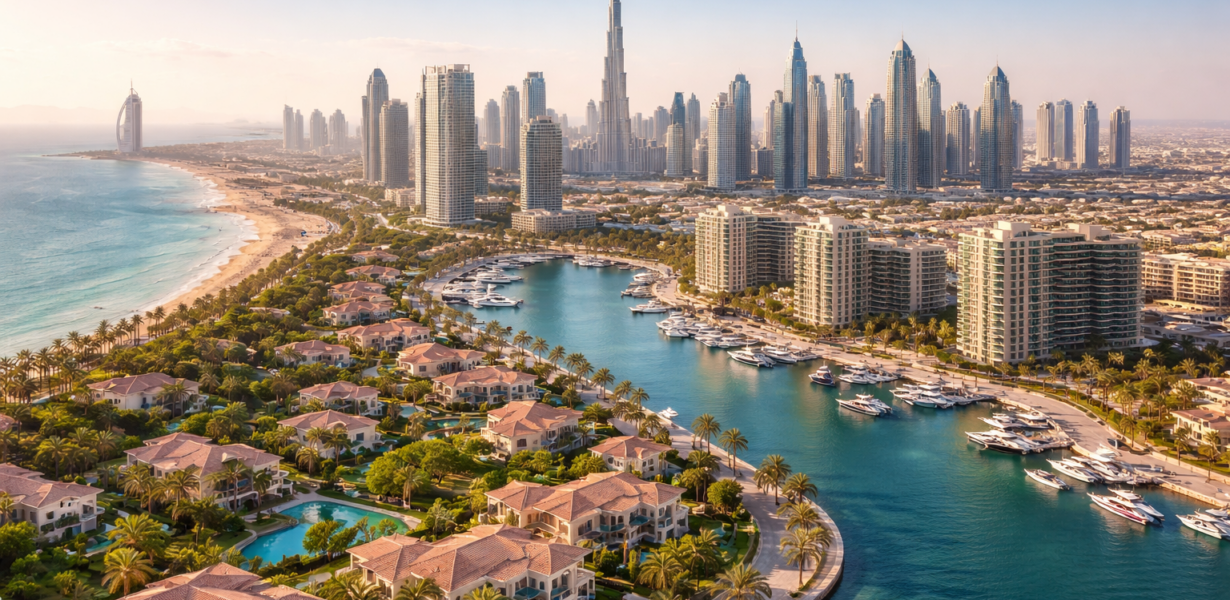
Dubai is developing at a rapid pace, and this momentum directly shapes living conditions across different parts of the city. Emerging districts with ongoing construction attract buyers with a lower entry threshold: prices at early stages are significantly more affordable. However, such choices come with certain trade-offs. For investors, this often means difficulties in attracting tenants; for end users, it implies waiting for infrastructure to mature and living alongside active construction. Those who are not willing to wait should consider locations where infrastructure is already fully established.
What Defines a “Completed” District
A professional benchmark for completion is the implementation of 85–90% of the master plan. This means that there are virtually no vacant plots left for development, clinics, schools, shopping centers, and parks are fully operational, and the road network has reached its final form. By purchasing a property in such a location, you are acquiring a well-formed ecosystem where the likelihood of a new high-rise appearing in front of your windows is minimal.
Dubai Marina
A benchmark of dense, fully completed development, where every square meter has long been utilized. This is a vertical city with an integrated transport system, including a tram and water taxis, as well as a well-established retail environment along the promenade. New projects here are rare and typically limited to infill redevelopment. The result is consistently high rental demand and predictable returns.
Jumeirah Village Circle
In recent years, the district has evolved from a promising development site into one of the emirate’s most sought-after family hubs. Circle Mall, parks, and all supporting infrastructure are already fully operational, and construction in the central circles is nearly complete. The area attracts expats with its combination of affordable prices and full-service amenities within walking distance. It is here that real estate in Dubai https://myestateinvest.com/en/uae/dubai/ is often perceived as one of the safest long-term ownership options.
Dubai Hills Estate
An example of well-executed master planning, where the active construction phase is largely behind. The central park, international schools, and one of the city’s largest shopping malls are fully operational. Landscaping and infrastructure works have been completed, and the district has reached its final form. The family segment values this area precisely because the surrounding environment is no longer in flux.
Arabian Ranches
A classic example of Dubai’s villa communities, offering a suburban atmosphere undisturbed by new large-scale developments. It is a self-sufficient community with established management standards, a developed internal road network, and mature landscaping cultivated over years. The absence of vacant land for large-scale construction ensures privacy for homeowners – an essential factor for premium properties.
Al Barari
A gated ecosystem with one of the lowest development densities in the emirate. The project was originally conceived as a limited collection of residences, so large-scale construction was neither planned nor expected. Existing infrastructure – from organic restaurants to wellness centers – is tailored to a narrow circle of residents for whom tranquility and environmental quality are the primary selection criteria.
A completed district is not just about the absence of construction noise – it is about asset predictability over a multi-year horizon. What unites these locations is that their development trajectory has already been defined: buyers enter an established environment rather than financing its creation. For investors, this translates into reduced risk; for end users, it means the ability to live comfortably without waiting for the area to evolve.