
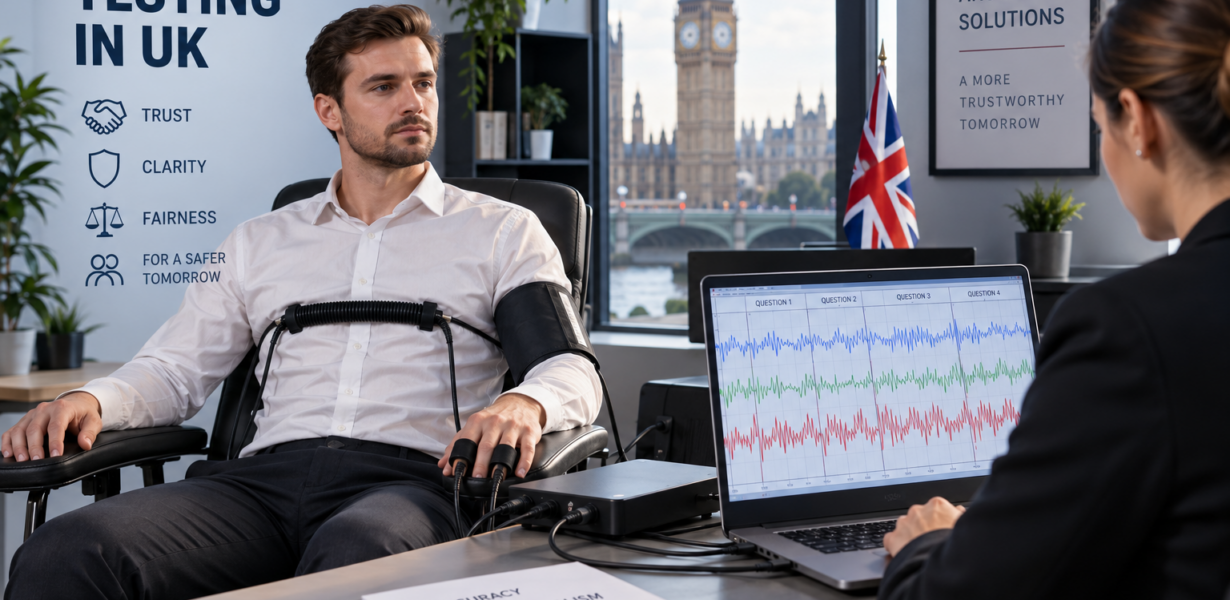
Polygraph testing is used by people who want greater clarity about a specific event when conversations, documents, or other available information have not resolved the issue. In the UK, private lie detector tests may be considered in relationship disputes, workplace investigations, theft allegations, business conflicts, and other situations where one clearly defined factual question needs to be examined.
A professional polygraph test is much more structured than the dramatic “lie detector” scenes often shown on television. The examiner does not simply connect a person to a machine and decide whether every answer is true or false. A large part of the process takes place before the recording begins, including a detailed interview, discussion of the issue, and careful preparation of the questions.
Why People Use Polygraph Testing
Most private clients consider a polygraph because a specific disagreement cannot be resolved through ordinary discussion. The goal should be to clarify a factual issue, not to judge someone’s personality or predict future behaviour.
Common reasons for testing include:
- suspected infidelity or undisclosed contact;
- missing cash, valuables, or company property;
- workplace theft or information leaks;
- disputes between business partners;
- questions about a specific meeting, transaction, or incident;
- allegations that a person says are false.
Relationship and Family Issues
Relationship tests usually focus on a clearly defined event or period. For example, a client may want to establish whether a partner met a particular person, maintained prohibited contact, or engaged in a specific act during an agreed timeframe.
Questions such as “Did you meet X in person after 1 January?” are more suitable than vague questions such as “Do you love your partner?” or “Will you ever cheat?” A polygraph is designed to examine factual past behaviour, not emotions, intentions, or predictions.
Workplace and Business Investigations
Businesses may consider polygraph testing after other checks have failed to resolve a specific incident. Possible examples include missing stock, cash shortages, unauthorised disclosure of confidential information, misuse of access credentials, or deliberate damage to company property.
A polygraph should not replace normal investigative methods. CCTV, access logs, accounting records, documents, and witness statements should usually be reviewed first. Employers should also consider employment and data-protection obligations before proposing testing to staff.
What Does a Lie Detector Measure?
The expression “lie detector” can be misleading because the equipment does not directly detect lies or read thoughts. A polygraph records physiological activity while the examinee answers a controlled series of questions.
Depending on the system used, the recorded signals may include:
- respiration;
- cardiovascular activity;
- changes related to blood pressure;
- electrodermal or skin conductance responses.
The examiner evaluates patterns in these reactions across several question sequences. The result therefore depends not only on the equipment but also on proper test design, clear wording, suitable testing conditions, and professional interpretation.
How a Professional Polygraph Examination Works
1. Initial Consultation
The first step is to identify the exact issue. A client may initially want to ask many broad questions, but a professional examiner will usually narrow the examination to one clearly defined topic that can be tested properly.
2. Pre-Test Interview
Before any sensors are attached, the examiner discusses the circumstances with the person being tested. The subject should understand the purpose of the examination and know the relevant questions in advance.
The pre-test interview normally covers:
- the reason for testing;
- the relevant events and timeframe;
- the meaning of important words or phrases;
- factors that could affect testing;
- the exact wording of the questions.
3. Recording the Test
The examiner attaches non-invasive sensors that record physiological responses. Several question sequences may be completed so that the examiner has enough data for comparison rather than relying on a single reaction.
4. Analysis and Report
After the recording stage, the examiner reviews the charts using the selected testing method. A proper conclusion should be based on the complete set of relevant data rather than one unusually strong reaction.
Depending on the provider, clients may receive an initial result after the examination and a written report later. The exact format, timing, and cost should be confirmed before booking.
What Questions Work Best in a Polygraph Test?
The usefulness of a polygraph depends heavily on the quality of the questions. Narrow, factual questions are generally more appropriate than broad questions about feelings, character, or possible future behaviour.
| Situation | Suitable Focus | Unsuitable Focus |
|---|---|---|
| Missing money | Whether the person took a specific sum | Whether the person is generally honest |
| Relationship dispute | Whether specified contact occurred | Whether the person truly loves their partner |
| Information leak | Whether identified information was disclosed | Whether the person may leak information in future |
| Missing property | Whether the person removed a specific item | Whether they know who is “untrustworthy” |
Questions should also avoid combining several allegations into one sentence. If different actions need to be examined, they may need to be separated so the subject understands exactly what is being asked.
Legal and Practical Considerations in the UK
Private polygraph testing and official government use of polygraphs are different. A private test should not be treated as automatic legal proof simply because an examination has taken place.
Consent, confidentiality, data handling, and the purpose of the examination should be clear before testing begins. Where a test relates to an employment dispute, criminal allegation, or possible court proceedings, obtaining appropriate legal advice may be sensible.
Workplace Testing
Employers need to consider worker privacy, proportionality, and data-protection requirements. A signed consent form does not automatically resolve every legal issue, particularly where an employee may feel pressured to participate.
For that reason, a workplace polygraph should be considered as one possible investigative tool rather than a replacement for normal evidence gathering and professional employment advice.
Official Use of Polygraphs
Polygraphs are also used in defined circumstances within offender-management systems in England and Wales. These official programmes operate under specific legal and procedural rules and should not be confused with privately commissioned relationship or commercial tests.
How Accurate Is Polygraph Testing?
Accuracy is one of the most common questions, but no single percentage can describe every possible examination. Results can be affected by the examiner’s training, methodology, question design, testing conditions, the suitability of the examinee, and the quality of chart interpretation.
Any accuracy figure advertised by a provider should therefore be understood as a stated performance claim rather than a guarantee for every individual case.
For private clients, the most practical approach is to view a polygraph as an additional source of structured information about a specific issue rather than a machine capable of establishing every fact surrounding a complicated dispute.
How to Prepare for a Lie Detector Test
Preparation is usually straightforward. There is no need to rehearse answers or change normal routines without professional advice.
Before the appointment:
- get a normal amount of sleep;
- eat regular meals;
- avoid arriving exhausted or intoxicated;
- allow enough time to reach the appointment without rushing;
- bring any identification requested by the provider;
- tell the examiner about relevant medication or health issues;
- review every question carefully during the pre-test interview.
Do not stop prescribed medication solely because a polygraph test is scheduled. Medical decisions should remain with the healthcare professional responsible for your treatment.
When Testing May Need to Be Postponed
A professional examiner may postpone or decline a test if the person’s current physical or psychological condition could significantly interfere with the procedure.
Possible examples include acute illness, intoxication, severe immediate distress, extreme fatigue, or another condition that prevents normal participation. The examinee should provide accurate information before the test so that suitability can be assessed properly.
How to Choose a Polygraph Examiner
Choosing the examiner is as important as choosing the service itself. Before booking, ask how the test is structured and what is included in the price.
Useful questions include:
- What training and professional experience does the examiner have?
- What testing methodology is used?
- How are the final questions prepared?
- Is a written report included?
- How are personal information and results stored?
- What happens if the person is unsuitable for testing?
- Are there additional charges for more than one topic or person?
A good examiner should also be willing to explain when a question is too vague or when a particular dispute is not suitable for polygraph testing.
Arranging a Lie Detector Test in the UK
Before booking, write down the single most important factual issue you want to clarify. This will make the initial consultation more productive and help the examiner determine whether the matter is suitable for testing.
To review the available service format and arrange a consultation, visit the provider’s page for lie detector testing in UK. Checking the service details in advance can help you understand the process, discuss suitable questions, and choose an appropriate appointment.
Contact the provider before finalising the booking if you have questions about confidentiality, timing, the testing location, or whether your situation can be examined effectively with a polygraph.
Frequently Asked Questions
Is a polygraph the same as a lie detector?
Yes, in everyday language. “Polygraph” usually refers to the equipment and testing method, while “lie detector” is the more familiar term.
Can a polygraph read thoughts?
No. It records physiological responses while structured questions are asked. It does not read thoughts, memories, or intentions.
Will I know the questions in advance?
In a properly structured private examination, the relevant questions should normally be discussed and reviewed before recording begins.
Can I ask many different questions?
A longer list is not necessarily better. Polygraph examinations are generally more useful when they focus on one clearly defined issue or event.
Can nervousness affect the test?
Some nervousness is normal and expected. Professional testing relies on structured comparison rather than assuming that any sign of stress automatically means deception.
Can a private polygraph automatically prove something in court?
No. The legal significance of a private polygraph report depends on the circumstances and the type of proceeding. Anyone considering testing in connection with litigation should seek appropriate legal advice.
Using Polygraph Testing Responsibly
A polygraph is most useful when the question is specific, the procedure is transparent, and everyone understands what the result can and cannot establish.
Instead of asking whether someone is generally “telling the truth,” focus on a defined past event. A professional examiner can then determine whether the issue is suitable for testing, prepare clear questions, explain the procedure, and provide a result that can be considered alongside the other information available.