
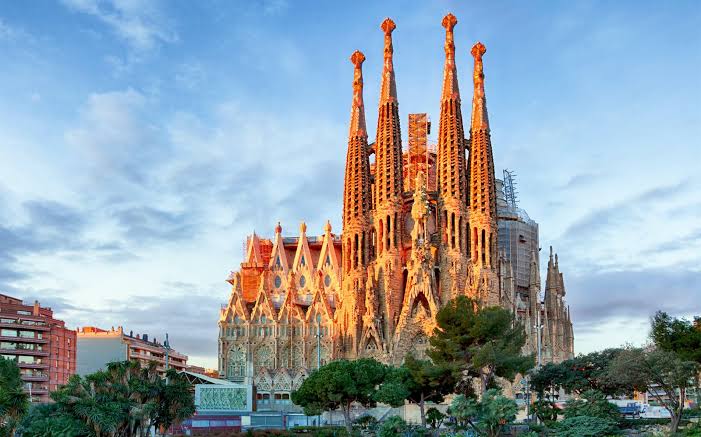
Stand outside the Sagrada Família any morning and you’ll hear the same conversation repeated in six languages: “did we book the towers?”, “which facade are we on?”, “why does it say Nativity on yours and Passion on mine?”. Half the visitors holding tower tickets couldn’t tell you which tower they’re about to climb, and a surprising number of people with basic tickets think they’re going up one.
The Sagrada Família ticketing system is not complicated because anyone wants to confuse you. It’s complicated because this is a working basilica, an active construction site and the most visited monument in Spain at the same time. This article explains what each ticket actually includes, the real difference between the two towers, when a guide changes the experience and when it doesn’t, and how to avoid the mistakes that can’t be fixed once you’re inside.
Quick check: which ticket do you actually need?
1. Is this your first visit?
2. Are you travelling with children or anyone with limited mobility?
3. Do you care about Gaudí’s story or just the building?
Why the Sagrada Família confuses people who did their homework
Most major monuments have one front door and one ticket. The Sagrada Família has two finished monumental facades on opposite sides of the building, each with its own towers, plus a third (the Glory facade, the future main entrance) still under construction. The basilica receives close to five million visitors a year, all of them entering on timed slots through the Nativity side.
Three things get lost even among well-prepared visitors:
- The two facades are not two versions of the same thing. The Nativity facade was built under Gaudí himself and looks like the stone is alive — plants, animals, figures spilling over each other. The Passion facade, built decades later to Gaudí’s plans but with Josep Maria Subirachs’ angular sculptures, is deliberately stripped and harsh. They’re meant to feel different: birth on one side, death on the other.
- “Tower ticket” means one tower group, chosen in advance. You pick Nativity or Passion when you book. Swapping on arrival is not a thing, no matter how politely you ask.
- The building is oriented, and so is the light. The Nativity facade faces the sunrise; the Passion facade faces the sunset. Inside, that means the blue-green glass on the Nativity side glows in the morning and the red-orange glass on the Passion side ignites in the late afternoon. The hour of your slot changes the interior more than any ticket upgrade does.
The ticket types, explained
| Ticket | What it includes | Approx. price (adult) | Best for |
|---|---|---|---|
| Basilica | Interior + audio guide app, timed entry | ~26 € | First visit, families with small kids |
| Basilica + tower | Interior + audio guide + lift up one tower (Nativity or Passion) | ~36 € | Return visitors, view hunters |
| Guided tour (official) | Interior with a licensed guide, small group, ~50 min | ~30-40 € | Solo travellers who want context without organising anything |
| Private tour (agency) | Licensed private guide, your own pace, usually combined with other Gaudí sites | from ~250 € per group | Families, groups, one-day visitors, cruise passengers |
All entries are timed. The official channel is sagradafamilia.org, and in high season (May to October) tower slots for the good hours sell out one to three weeks ahead. Same-day tickets at the door exist in theory and are a coin flip in practice.
Nativity or Passion: how to actually choose your tower
This is the decision people agonise over, and it’s simpler than it looks.
- Choose Nativity if you want Gaudí. These towers were finished in his lifetime or shortly after; the stonework you brush past on the spiral stairs is the original project. The bridge between the towers looks back over the facade’s sculpted surface, and the views sweep towards the sea. It’s also the side most photographed from Plaça de Gaudí’s pond.
- Choose Passion if you want the view and the modern story. The west side looks over the Eixample grid towards Montjuïc and Tibidabo, the light is better for photos in the afternoon, and you exit through the facade whose sculptures divide opinion like nothing else in Barcelona — which is exactly why they’re worth seeing up close.
Whichever you choose, the mechanics are the same: lift up, viewing points and bridge, then roughly 400 steps down a spiral staircase that narrows as you descend. It’s safe, but if you’re claustrophobic or have knee trouble, know what you’re signing up for.
How much time you really need
The standard visit numbers: 60 to 90 minutes for the basilica with the audio guide, plus 30 to 45 minutes if you add a tower (queue for the lift included). A guided visit runs about 50 minutes of explanation plus free time after.
What the numbers hide is that the interior rewards slowness at specific moments. Sit for ten minutes in the nave — actually sit, there are pews — and watch the light move. Most visitors photograph the ceiling in the first five minutes and leave in twenty-five; the ones who stay past the half-hour are the ones you see grinning on the way out.
When a guide is worth it — and which kind
The honest answer: the Sagrada Família is one of the few monuments where the audio guide is genuinely decent, because the building is its own best exhibit. A live guide earns the difference in three cases:
- You want the architecture decoded. The tree columns, the hyperboloid vaults, the geometry Gaudí borrowed from nature — a good guide makes a cathedral of engineering out of what the app narrates as trivia.
- You’re combining sites in one day. Park Güell, Casa Batlló, La Pedrera and the Sagrada Família in a single Gaudí day involves four ticketing systems and three neighbourhoods. An operator that handles the logistics — timed entries aligned, private vehicle between sites — turns a stressful checklist into an actual holiday. That’s the format of a private Gaudí tour of Barcelona with an official guide offered by full-service agencies.
- You have one day in Barcelona (cruise passengers, layovers). When the ship leaves at six, buffer management matters more than saving 40 €. Private operators with a driver build the day around your hard deadline; see for reference the private formats on private tours in Barcelona.
One legal note: guides working inside the basilica must hold an official Catalonia guiding licence. “Passionate local host” is a lovely phrase and not a licence — serious operators will confirm the credential in writing if you ask.
Best time to visit
- Best light inside: first slots of the morning (blue-green glow, Nativity side) or the last two hours before sunset (the red-orange western glass at full blast). Midday is the flattest light of the day.
- Quietest days: Tuesday to Thursday. Mondays collect everyone who found the museums closed; weekends collect everyone else.
- Quietest months: late November to February, excluding Christmas week. Same building, half the elbows.
- Avoid without checking: mass times (the basilica is a working church and access adjusts), and major holidays.
Frequently asked questions
Is the Sagrada Família finished now?
Can I switch my tower choice on the day?
Is there a dress code?
Are the towers suitable for someone afraid of heights?
Can I attend mass instead of buying a ticket?
How far in advance should I book?
The verdict
Buy the basic ticket and time it well, and you’ve already secured 80 % of what the Sagrada Família has to give. Add a tower if stairs don’t scare you and you’ve picked your facade for a reason — Gaudí’s stone on the Nativity side, the city view on the Passion side. Add a guide when the story matters to you or when the day involves logistics you’d rather not own: multiple Gaudí sites, a cruise deadline, a family that moves at three different speeds.
The one mistake that can’t be repaired is the timing one. The building runs on light. Book the hour first, the ticket type second, and everything else falls into place.